Clear, Kind, Understood: English Confidence for UK Care Work

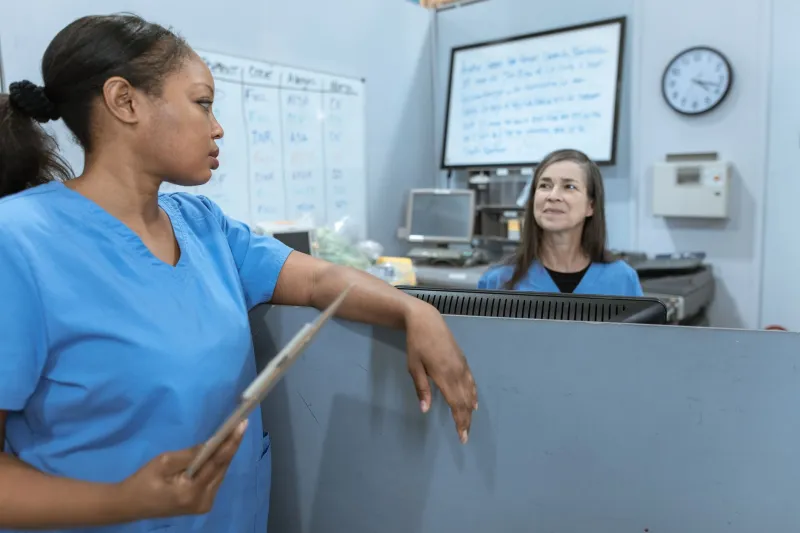
Photo: Keränen, Raimo, CC BY 4.0, via Wikimedia Commons
If English is not your first language, the idea of a care shift can feel daunting. You might worry about the handover, the phone call from a GP surgery, or whether you will understand a resident the first time they ask for something. That worry is normal. But it is worth saying plainly: UK care employers are not looking for perfect English. They are looking for clear, kind communication that keeps people safe and respected.
In 2026, care teams across the UK are more diverse than ever. You will meet colleagues who speak English as an additional language, colleagues with strong regional accents, and colleagues who have lived here all their lives and still mumble at 7am. The goal is not to sound like a newsreader. The goal is to be understood — and to understand others.
What employers actually need from your English
A care employer is not marking your grammar. They are asking a practical question: can this person communicate safely and warmly with residents, families and colleagues?
That usually means four things:
- You can follow instructions and check anything you are unsure about.
- You can ask for clarification without guessing.
- You can record facts clearly and honestly.
- You can speak kindly, even when a conversation is difficult.
An accent is not a barrier. Mumbling, rushing or pretending to understand is. The good news is that all three can be fixed with practice.
Phrases worth practising before an interview
Interviews are often where confidence dips. You do not need long, polished speeches. Short, clear answers work well. Try rehearsing a few phrases until they feel natural:
- ‘Sorry, could you say that again more slowly, please?’
- ‘Just to check I have understood — you mean I would support the resident with breakfast first, then record it?’
- ‘I am still learning some care vocabulary. Could you explain what that term means?’
- ‘In my last role, I worked with people who needed help with personal care. I always explained what I was doing before I started.’
If an interviewer uses a word you do not know, ask. It shows self-awareness, not weakness. You can also say: ‘I speak English as an additional language. I am confident with everyday communication, and I always ask when I need to.’ That is a clear, honest answer — and many managers will respect it more than a fluent bluff.
Handovers: keep it short and structured
Handover can feel like a wall of fast speech. You do not have to memorise everything. Use a simple structure so your own handover is easy to follow, and so you can listen for the same pattern when others speak.
Try this: person, change, action, question.
- Person: ‘Mrs Patel in room 12.’
- Change: ‘She has been more unsteady on her feet since lunch.’
- Action: ‘I helped her to the toilet and recorded it. She is due to be checked again at 3pm.’
- Question: ‘Can you keep an eye on her when she walks to the dining room?’
That structure works for home care visits too. It keeps you focused and gives the next worker a clear picture. If you miss something, ask at the end: ‘Can I just check the part about the afternoon medication?’ It is better to ask twice than to guess once.
Record-writing: plain facts, no performance
Care records are not creative writing. They need facts, times and direct observations. You do not need fancy words. You need clarity.
Instead of ‘Resident was fine’, write: ‘At 10:15, Mrs X said she felt dizzy when standing. I helped her sit down and took her blood pressure as instructed. She said the dizziness passed after five minutes. GP surgery called at 10:40.’
If a resident says something important, record their words in quotation marks where you can. If you are unsure how to spell a word, use a plain alternative or ask a colleague. A small dictionary or notes app on your phone can help during breaks — not on the floor during care.
When you do not understand
This is the part that matters most. In care, pretending to understand is a safety risk. Asking is a professional skill.
Useful phrases include:
- ‘I want to make sure I do this correctly. Can you show me once?’
- ‘I did not catch that. Could you repeat the last part?’
- ‘Do you mean the blue folder or the green one?’
- ‘I am going to write that down so I do not forget.’
Nobody minds a second question. They mind a missed medication, a missed drink or a resident left waiting because someone was too embarrassed to ask.
Showing employers your communication style
In an interview, you can show rather than tell. Give one example of a time you explained something clearly to a person who was confused or upset. Give another example of a time you asked for help. These are care skills, not language skills.
You can also mention any English classes or ESOL courses you have taken, but keep it brief. The focus should be on what you can do now: listen, check, record and speak kindly. If you are applying through All Care Jobs, look for employers that mention induction, shadow shifts and buddy systems. Those are good signs that they support people who are still building confidence.
Building confidence day by day
Confidence comes from repetition, not from waiting until you feel ready. Try these small habits:
- Learn five care-related words each week and use them in a sentence.
- Record yourself giving a two-minute handover, then listen back once.
- Ask a trusted colleague to correct one phrase gently.
- Watch how experienced staff explain personal care before they start.
- Keep a notebook of phrases that come up often.
You will make mistakes. Everyone does. The standard is not perfect English. The standard is safe, respectful communication — and that is something you can build shift by shift.